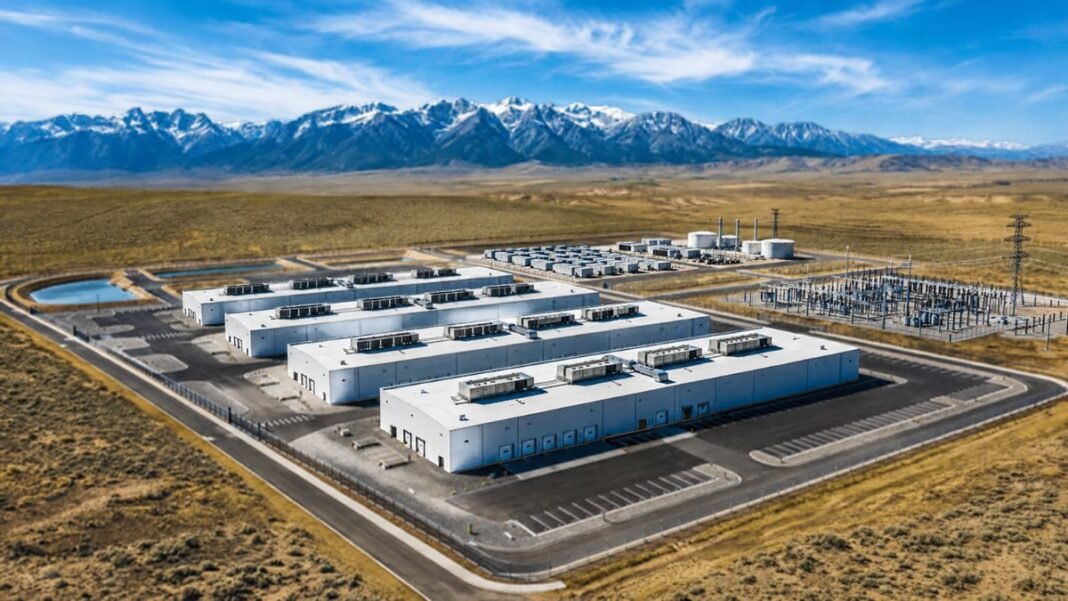

The Google Wyoming data center is a $17 billion bet on the plains of the state’s southeast. The company has confirmed the Google Wyoming data center, its first in the state, a sprawling campus near Cheyenne designed to power the artificial intelligence services that are driving a global race for computing capacity. The project stands out not only for its size, but for how it plans to get its electricity, and for the timing of the announcement amid a growing public backlash against data centers in the United States.
Table of Contents
Google Wyoming data center at a glance
- Investment: $17 billion, described by Google as a long-term commitment.
- Location: Laramie County, Wyoming, in the Switchgrass Industrial Park about eight miles south of Cheyenne.
- Site size: Roughly 716 acres, with plans for four data halls plus office, logistics and network buildings, according to industry publication Data Center Dynamics.
- Timeline: Full build-out is targeted for 2031, according to industry reports.
- Jobs: Around 250 direct operating roles, plus construction work during the build.
- Partners: Tallgrass Energy, Black Hills Energy, American Electric Power (AEP) and Related Digital.
Google announced the project on November 5, 2026, in a blog post by Steve Walter, its vice president of global infrastructure and energy.
Powered by fuel cells and carbon capture
The most unusual part of the plan is its energy supply. The campus will be backed by a 702-megawatt fuel cell development, with the fuel cells manufactured by Bloom Energy. These fuel cells run on natural gas, but rather than burning it, they convert it to electricity through an electrochemical process.
The emissions are where the second piece comes in. The project includes carbon capture and storage (CCS): most of the carbon dioxide produced will be captured and piped to Tallgrass Energy’s Eastern Wyoming Sequestration Hub, where it will be stored permanently deep underground.
Google has also pledged to pay for 100% of the power the Google Wyoming data center uses. That commitment speaks directly to a common worry in communities that host data centers: that ordinary households end up paying more for electricity because of the grid upgrades these huge facilities require.
Saving water with air cooling
Data centers generate enormous heat, and many rely on water-based cooling systems that can consume millions of litres a day. In a semi-arid state like Wyoming, that would be a hard sell. Google says this campus will be air-cooled to reduce strain on local water supplies.
A rocky road to get here
The Wyoming site was not originally Google’s project. It was first being developed by Crusoe, a so-called neocloud company that builds AI computing infrastructure. In June, Bloomberg reported that Crusoe had been pushed out of the project after Google raised concerns about costs and the timetable under Crusoe’s management. Black Hills Energy’s agreement to supply power to the campus took effect in October.
Arriving in the middle of a backlash
The announcement comes at a sensitive moment for the industry. In the November 2026 US midterm elections, 40 of the 41 ballot measures related to data centers went against them, according to Ballotpedia. Several winning candidates in states such as Texas and Georgia campaigned on slowing data center growth, and in Wyoming itself, prominent politicians have voiced skepticism about the wave of projects coming to the state.
Critics raise several concerns:
- Electricity prices: Fears that power-hungry campuses will push up bills for local residents.
- Water use: Pressure on scarce water in dry regions.
- Emissions: Reliance on natural gas, even with carbon capture, rather than fully renewable sources.
- Jobs versus investment: Data centers cost billions but employ relatively few people once running.
Google’s design choices, including paying for its own power, air cooling and carbon capture, appear aimed squarely at those objections.
Why it matters
The AI boom is no longer just about who builds the smartest model. It increasingly depends on who can secure land, power and permits fast enough to run those models at scale. Big tech firms are spending record sums on infrastructure, and finding reliable electricity has become one of the biggest bottlenecks.
For the state, the Google Wyoming data center promises a major boost to the local tax base and new economic activity. For Google, it is another piece of the physical backbone it needs to compete in AI. And for the wider industry, it will be a closely watched test of whether new approaches to power and cooling can win over communities that are increasingly saying no.
Also read: Italy fines Meta €805 million over Facebook photo access.