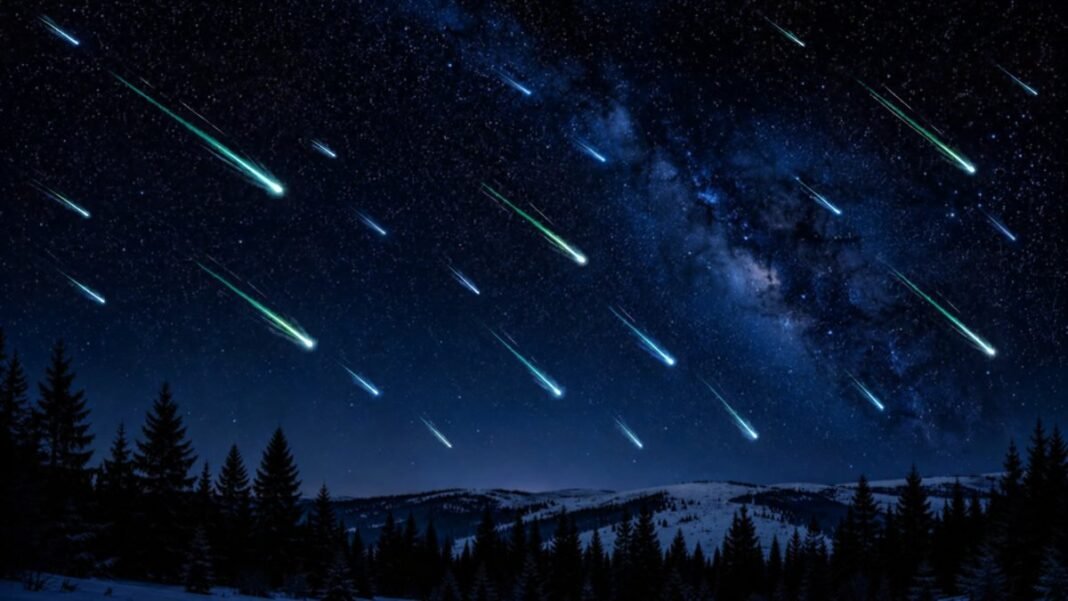

The best meteor shower of the year is almost here. The Geminid meteor shower 2026 peaks on the night of December 13 to 14, 2026, and this year the conditions are excellent: the Moon is only a thin crescent and sets early, leaving dark skies for the best hours. Under a clear, dark sky you could see well over 100 shooting stars an hour. Here is when and where to look, and how to get the best view.
Table of Contents
Geminids 2026: key dates and times
- Active period: roughly December 4 to December 20
- Peak night: December 13 to 14, 2026
- Predicted peak: around 05:44 UTC on December 14
- Best time to watch: from about 10 p.m. until dawn, with the highest rates around 2 a.m. local time
- Expected rate: up to about 120 to 150 meteors per hour under ideal dark-sky conditions
Because the peak is broad, the nights of December 12 to 13 and December 14 to 15 are also worth trying if the weather is cloudy on peak night.
Why 2026 is a great year for the Geminids
Moonlight is the biggest enemy of meteor watching. In some years, a bright Moon can wash out most of the fainter meteors. In 2026, the New Moon falls on December 9, so on the peak night the Moon is only a slim waxing crescent that sets in the evening. That means the darkest hours, when the shower is strongest, will be largely moon-free.
What makes the Geminids special
- They come from an asteroid. Most meteor showers come from comets, but the Geminids are linked to an asteroid called 3200 Phaethon.
- They are bright and colourful. Geminid meteors are often slower and brighter than other showers, sometimes showing yellow, white or green hues.
- They start early in the evening. Unlike many showers that only get going after midnight, the Geminids produce meteors from mid-evening.
- They are reliable. The Geminids are considered the strongest and most dependable annual shower.
Where to look in the sky
Geminid meteors appear to come from a point called the radiant, near the bright star Castor in the constellation Gemini. The radiant rises in the east in the evening and climbs high in the sky by around 2 a.m.
But you do not need to stare at the radiant. Meteors can appear anywhere in the sky. The best approach is to look at a wide area of dark sky, ideally about 40 to 60 degrees away from Gemini, where meteor trails appear longer.
How to watch the Geminid meteor shower
- Get away from city lights. A dark rural spot makes a huge difference. Even moving to a park or the edge of town helps.
- Let your eyes adjust. Give yourself 20 to 30 minutes in the dark without looking at your phone.
- Use red light if needed. Many phones have a red-screen or night mode that protects your night vision.
- Lie back and look up. A reclining chair or a blanket on the ground is ideal.
- Dress warmly. December nights can be very cold in the Northern Hemisphere. Bring layers, a hat, gloves and a hot drink.
- Be patient. Meteors come in bursts. Give it at least an hour.
No telescope or binoculars are needed. In fact, they narrow your view and make meteors harder to catch.
Can you see the Geminids from the Southern Hemisphere?
Yes, but rates are lower. The Geminids are best seen from the Northern Hemisphere, including the US, UK, Canada, Europe and India. Observers in Australia and other southern locations can still see some meteors, but the radiant sits lower in their sky, so expect fewer.
Tips for photographing the Geminids
- Use a camera on a tripod with a wide-angle lens.
- Set manual focus to infinity and use exposures of 15 to 30 seconds.
- Take continuous shots for an hour or more; you can combine the best frames later.
- Many newer smartphones have night or astrophotography modes that can capture bright meteors if mounted on a tripod.
The bottom line on Geminid meteor shower 2026
Mark the night of December 13 to 14, 2026 in your calendar. With a dark, moon-free sky expected for the best hours, this could be one of the best Geminid displays in years. Find a dark spot, dress warmly, look up around 2 a.m. and enjoy the show. Mark your calendar now so you do not miss the Geminid meteor shower 2026 peak.